

The Athenaeum of Philadelphia was founded in 1814 and has since served as a library. The city did not yet have public libraries at the start of the nineteenth century, hence the goal of this institution was to provide everyone with access to knowledge. The collection contained books, archive documents and special sections. Furthermore, the institution offered space for lectures and public events. Learn more at philadelphia1.one.
The Athenaeum relocated to its own building in 1847. It was designed by John Notman and became a true architectural gem of the city. Continue reading this article to learn more about the appearance and interior world of the Athenaeum.
Foundation and new building
The Philadelphia Athenaeum is one of the city’s oldest and most recognized institutions. Its history started in 1814. Back then, it was established as Philadelphia’s first subscription library. The institution gave its members access to literature and collected historical materials on art and architecture. So, they were able to gather a significant archive of architectural drawings, photographs and manuscripts that can be used to study the history of the development of Philadelphia.
At the beginning of its operations, the library did not have a permanent site and moved throughout several locations. For some time, it operated on the basis of the American Philosophical Society. However, this was inconvenient, and the frequent relocation required time and effort, not allowing for significant expansion of the collection.
The Athenaeum’s own building appeared in 1847 on Washington Square. The project was commissioned by architect John Notman, who designed the Laurel Hill Cemetery and Episcopal churches.
When the construction was finished and the library moved to its new location, it only took up the second floor. The first and third floors were occupied by tenants. For example, the American Institute of Architects was housed on the third level, while the local school district rented a space on the first floor. In 1857, the National Educational Association was founded here, and in 1884, the American Catholic Historical Society was established in the building.
Building design and its significance for the city
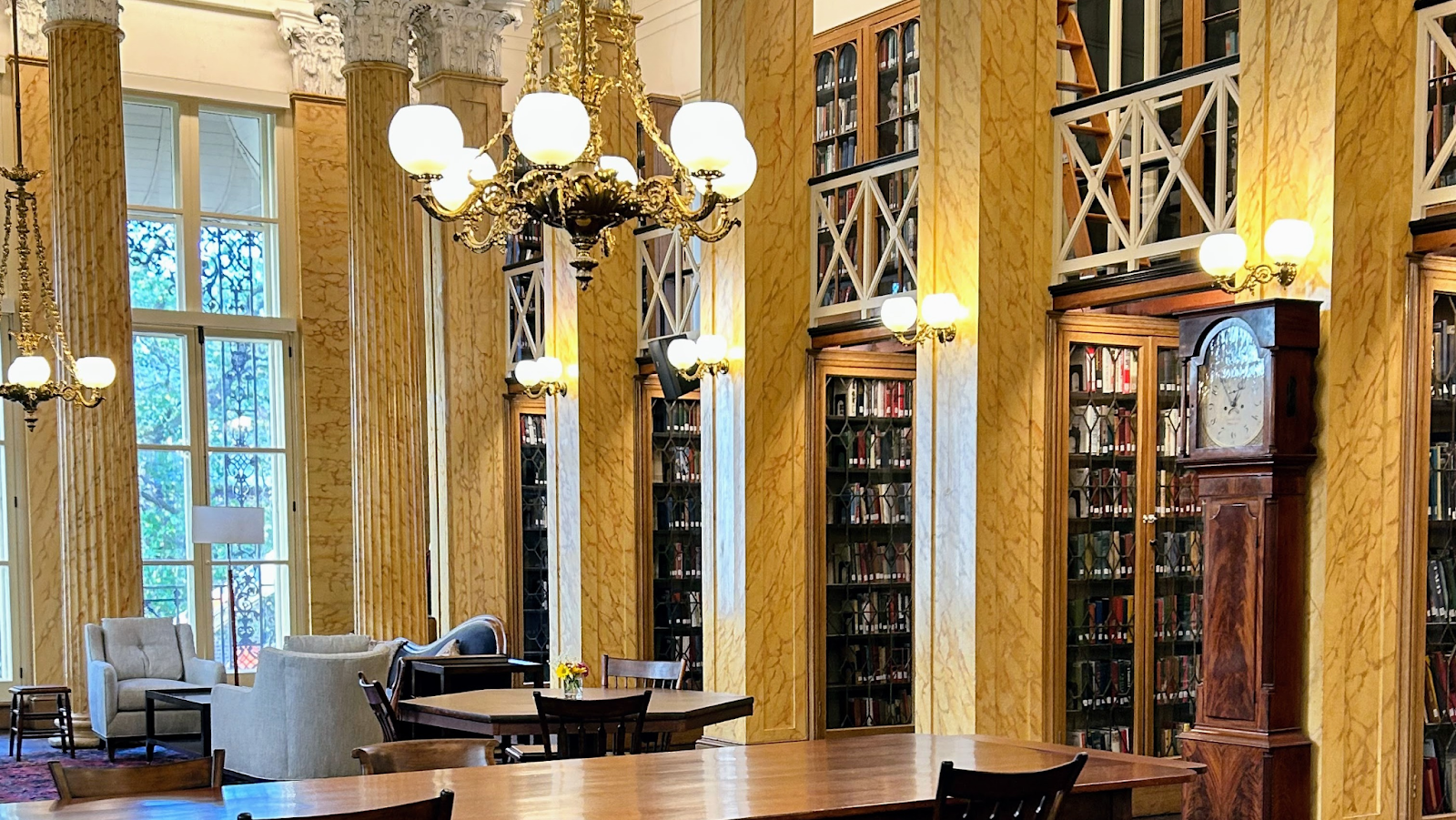
The Athenaeum’s design became unique both in terms of style and materials. It was one of the earliest structures in Philadelphia to use brownstone rather than brick. The architect used elements of the Italian Renaissance period, which ultimately became popular and prevalent throughout the city.
Interestingly, he planned both the main building and a brick toilet in the garden. It featured a stone structure and six compartments accessible from the outside. Unfortunately, it was destroyed by a fallen tree in 1962.
Since its inception, the building of the Athenaeum attracted the attention of citizens and architects, so:
- in 1957, it was added to the Philadelphia Register of Historic Places
- in 1999, it was listed on the local register as a contributing structure
- in 1972, it was added to the National Register of Historic Places and later recognized as a National Historic Landmark.
However, over time, the building’s beauty deteriorated. When it celebrated its 175th anniversary, it became clear that it required extensive repairs to both its outside facade and nearly all of its interior spaces. Such a necessity was not disregarded in the city, and the Athenaeum was able to revive in its full glory.
Repairs and restoration
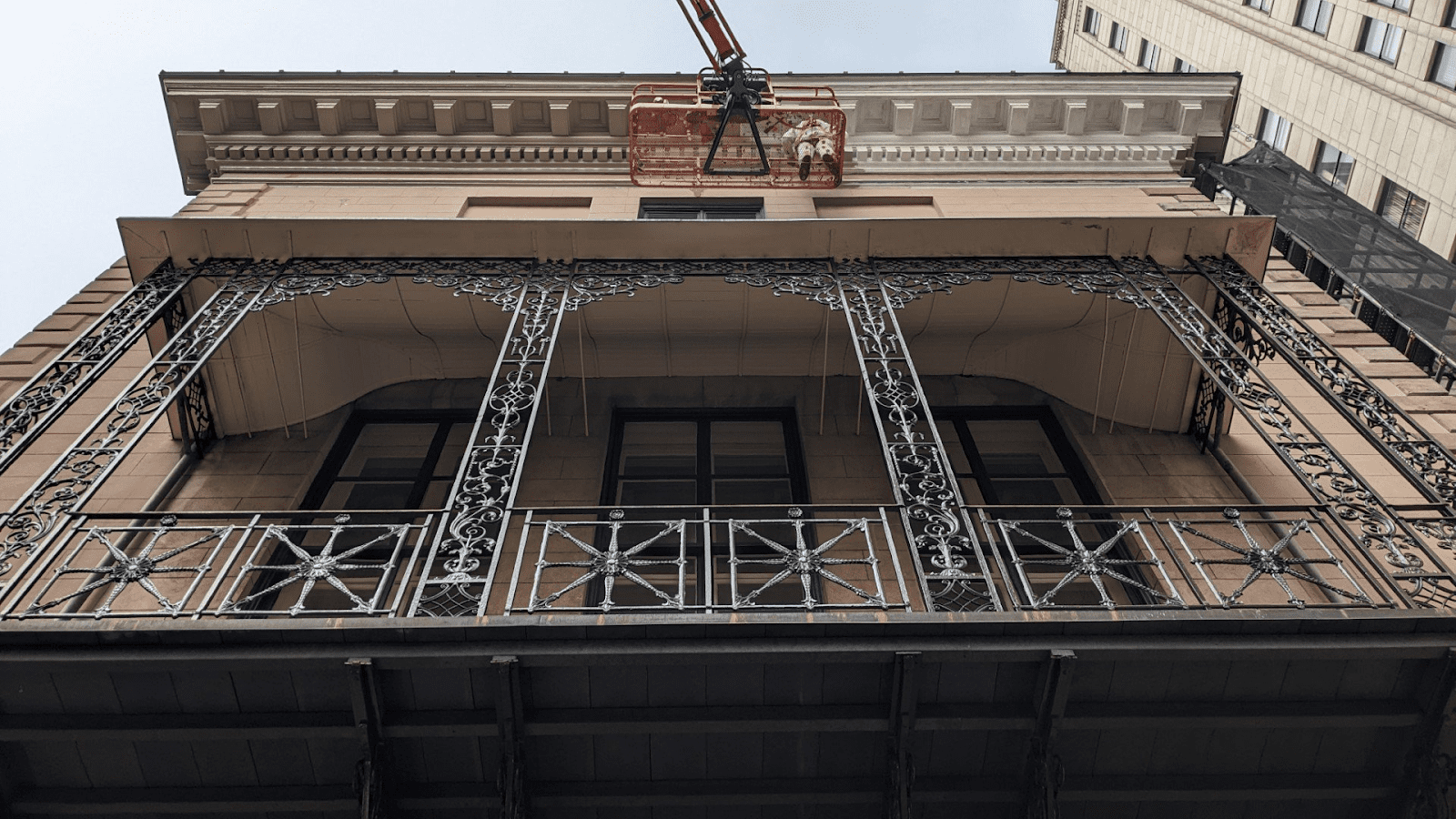
The large-scale reconstruction work began in 2021 with the roof replacement. This resulted in considerable changes to the building’s appearance. The project’s cost was 1.3 million dollars. Worn stones and plaster were replaced, timber elements were restored and the facade was cleaned. In addition, the plan included adding lighting for safety as well as highlighting the structure’s beauty in the evening and night.
This process lasted around six months. It is worth mentioning that many of the detrimental effects of prior unsuccessful repairs have also been addressed. Some of them were incompatible with the building’s materials and general architectural design.
Important architectural details such as a wooden cornice and a stone balcony required significant effort. They were completely dismantled and then reassembled. The workers were interested in discovering the construction methods of past centuries and evaluating them. At the same time, it was critical to save all of the small details and then accurately recreate them.
A lot of time was also spent on restoring the facade, which had become very dirty and had lost its natural colors. During the repair, the workers made significant effort working with the stones, selecting materials and colors that matched the original ones. That is why professionals can quickly tell the difference between the structure in photographs taken several years ago and how it appears today. In reality, the Athenaeum reappeared in all its splendor.
In the twenty-first century, this unique institution continues to promote learning, research and communication. Here, they always strive to take into account and address the needs of the community. As it was two centuries ago, the emphasis remains on knowledge and free access to it. Philadelphia boasts a wide network of public libraries, but the Athenaeum remains an atmospheric institution with an interesting history that is worth visiting.