

The story of Philadelphia’s “Lorraine Apartments,” also known as the “Divine Lorraine,” began in 1892. That year, a luxurious and comfortable apartment building was erected at the corner of Broad Street and Fairmount Avenue. It was later transformed into a hotel, eventually becoming the first establishment in the city open to people of all races and faiths. You can find more about its history at philadelphia1.one.
Despite its architectural and historical significance, the hotel fell into disrepair in the early 20th century. For a long time, the building remained boarded up, its windows covered and walls defaced with graffiti. Life returned to its historic halls in 2015, and since then, the hotel has been undergoing a revitalization.
Luxury and Comfort at the Lorraine Apartments
The 1880s marked a period of rapid and dynamic growth for Philadelphia. The city saw an emergence of wealthy individuals who yearned for a life of luxury, starting with opulent residences. However, most buildings in the city at the time were limited to three or four stories. Constructing taller buildings was challenging and considered impractical for living due to the absence of elevators.
Against this backdrop, the completion of the “Lorraine Apartments” in 1892 was a true architectural triumph. This ten-story building became one of Philadelphia’s first high-rises. For architect Willis Hale, it was one of several such projects that brought him fame and fortune. Yet, by the early 20th century, his architectural style faced criticism as simpler forms gained popularity.
The “Lorraine Apartments” didn’t just boast a lavish exterior. Inside, it was equipped with electricity and a kitchen that offered meal delivery service. The owners even hired staff so residents wouldn’t need to find their own help. Essentially, it operated as an elevated apartment building, providing unparalleled comfort for the city’s elite.
Father Divine’s Transformative Role
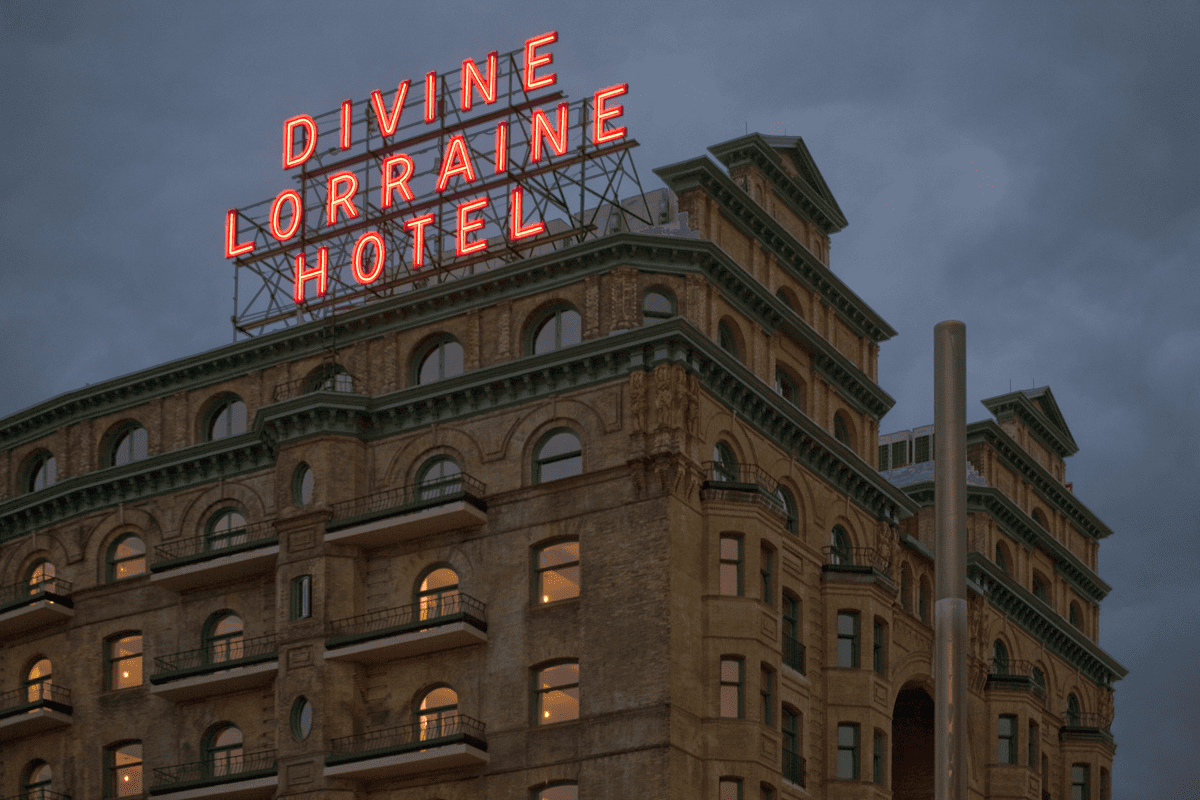
In 1948, Father Divine, the leader of the International Peace Mission movement, acquired the building for $485,000. He envisioned transforming it into a hotel for everyone, renaming it the “Divine Lorraine Hotel.” This establishment became a groundbreaking institution, the first in Philadelphia—and arguably the United States—to welcome people of all races, faiths, genders, and backgrounds. However, all guests had to adhere to specific rules:
- No smoking or alcohol consumption was permitted.
- Offensive language was strictly forbidden within the hotel premises.
- Men and women were required to reside on separate floors and were not allowed to visit each other’s rooms.
Additionally, women staying at the hotel were expected to wear only dresses or long skirts and maintain a modest appearance. Pants were not allowed.
The new owner genuinely believed in the equality of all people before God and was dedicated to helping the less fortunate. To that end, he created a prayer hall on the 10th floor, open to all. The ground-floor kitchen was converted into a public dining room, where visitors could purchase affordable, quality meals.
The hotel operated under these principles for nearly half a century. Meanwhile, the building’s architectural significance and historical value were gaining recognition within the city. In 1994, it was designated by the Pennsylvania Historical and Museum Commission, and in 2002, it was added to the National Register of Historic Places. By then, however, the hotel had ceased operations, and the building itself had fallen further into disrepair, remaining vacant.
Decline and Rebirth
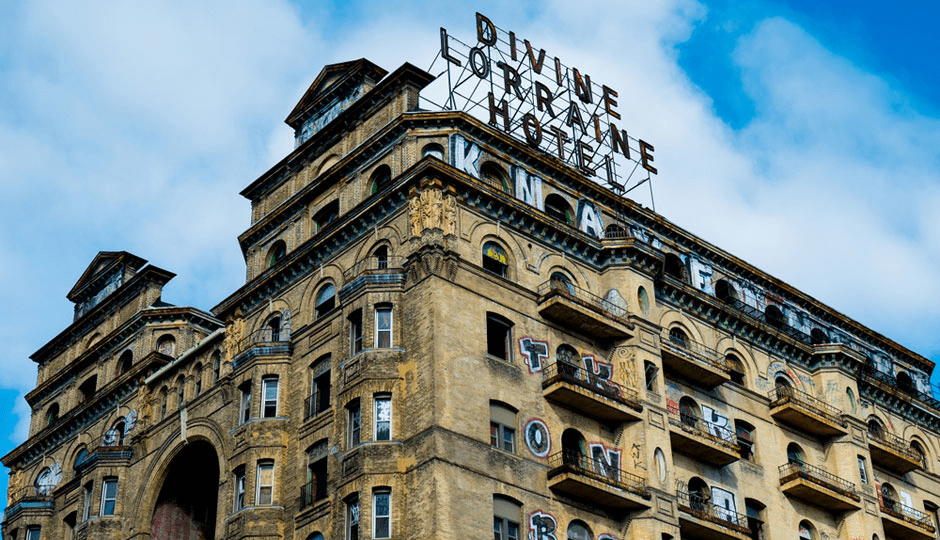
The hotel closed its doors in 1999, and the International Peace Mission sold it the following year. New owners showed little interest in developing the property. The building remained unused until 2006, when it was sold again, this time with plans for conversion into apartments. During this sale, the owners liquidated the furniture and virtually everything else that remained inside the former hotel. It became a hollow shell, its windows shattered and boarded up. Graffiti covered its walls, and it quickly lost all its former grandeur and beauty, transforming into a desolate husk.
In 2021, Eric Blumenfeld acquired the abandoned former hotel at auction. He was the only developer to express interest in the property. In 2015, he announced ambitious plans for a comprehensive renovation, aiming to create rental units and a ground-floor restaurant to restore the building’s profitability. That same year, the developer secured a loan for the renovations and began work. The Philadelphia Historical Commission approved a plan to restore the hotel’s exterior to its 1933 appearance. Within a year, most of the interior spaces were refurbished, and the “Divine Lorraine” name was reinstalled on the rooftop.
Soon after, the first tenants moved in. However, the former hotel required significant capital investment, and by 2020, the developer had fallen behind on his loan payments. It was then that he decided to once again transform the building into a full-fledged hotel. A portion of the building was rebranded as “Mint House” and began operating as a hotel.
In January 2025, a section of the new hotel was again closed. Currently, rental units and commercial event spaces are operational. Ownership of the building has now transferred to the creditors, who have a new goal: to convert the “Lorraine Apartments” back into a residential apartment building. Perhaps, in time, history will indeed come full circle.