

Nowadays, coffee is an essential part of everyone’s life. However, who is responsible for this trend’s emergence and active integration into people’s daily lives? Residents of every country and city at some point experienced the first taste of a fragrant drink that left few indifferent. In Philadelphia, this happened in the eighteenth century. This was the time when people used to travel by horse-drawn carriages, and slavery was widespread, but even back then coffee shops existed. Find out more at philadelphia1.one.
General information about the origins of coffee and the impact of coffee shops on society
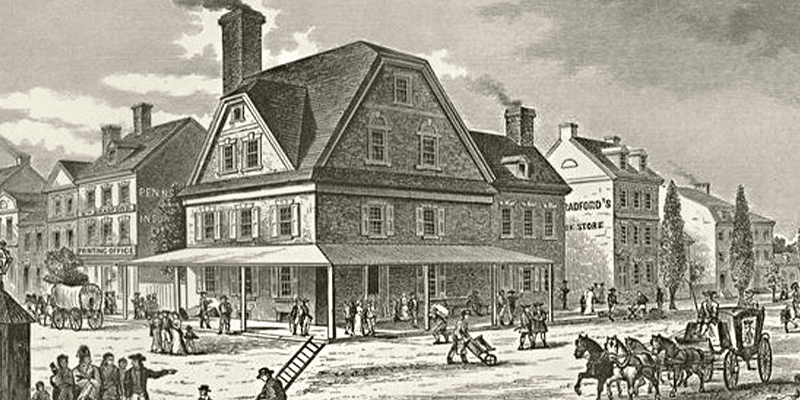
In 1682, William Penn started a Quaker colony in Delaware. According to common belief, he was the one responsible for the introduction of this drink, the popularity of which later spread to Philadelphia. In addition to bringing coffee to the city, he brought the so-called drink of human brotherhood, tea. Initially, all of the drinks were thought to be solely available to the wealthy, who drank them in small sips. Coffee lost its popularity at some point. Tea, on the other hand, started to be actively consumed in daily life.
In 1765, a tea tax was enacted, prompting the Pennsylvania colony to join other representatives in a boycott against the drink. During this time, coffee became the most popular beverage among Philadelphia citizens.
Over time, the city’s coffee shops came to play an important role in society. There were beautiful establishments with distinctive colonial architecture that everyone wanted to visit for their exuded romantic and peaceful atmosphere. The main halls of coffee shops have seen the appearance of numerous civil, sociological and industrial reforms.
Over the years, the city had four main establishments. The early coffee shops became regular meeting places for a variety of representatives, including Quaker municipal workers, ship captains and merchants. They all gathered to sign public and private agreements. However, before the Revolution occurred, ardent colonists, many of whom were dressed in Quaker clothes, began to meet in the establishments. All of this occurred to oppose the British oppression of the colonies. Following the Revolution, city officials visited coffee shops for lunch and social gatherings.
Appearance of the first Ye Coffee House
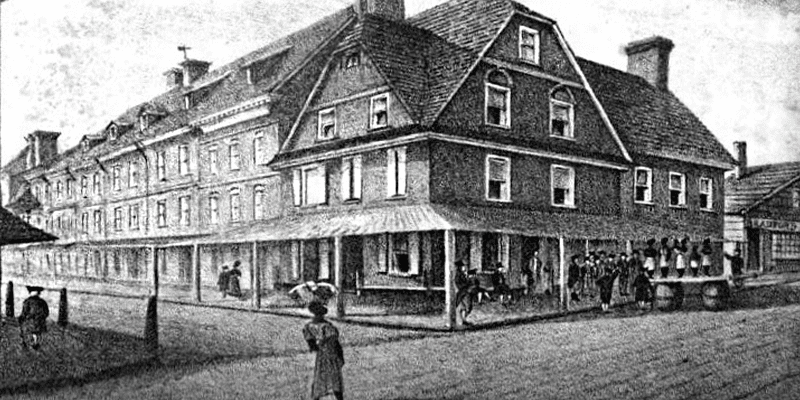
It is commonly believed that the first coffee shop in the city was established in 1700. John F. Watson wrote about this in his “Annals of Philadelphia,” although one page claims it happened in 1700, while the other says it happened in 1702. However, the earlier date is believed to be more correct because it was justified by other authors, Scharf and Westcott, in their work “History of Philadelphia”. In any case, there is no doubt that the coffee shop was the first and only one for several years. It was known as Ye at the time, and it was built by Samuel Carpenter.
Unfortunately, it is unclear how long the coffee shop has existed. The last mention of it was in colonial records, namely in a real estate conveyance from Carpenter to Samuel Finney. The documents were dated April 26, 1703, the fate of the institution after that is unknown.
The owner of Ye was Henry Flower, who also served as a postmaster. Due to his profession, it is claimed that the coffee shop once served as a post office. Benjamin Franklin’s Pennsylvania Gazette also stated that anyone who owed the late postmaster money could pay it in Ye. There is also speculation that the founding father was also involved in the popular coffee business. After all, in one of his newspapers, he advertised about a printer who sells very good coffee, which might be considered a self-promotion.
The second coffee shop in the city
The next coffee shop in the city became known as the first London Coffee House. The first establishment with this name was founded in 1702, however, there are some doubts about its location, as it is uncertain. According to the historical register, William Rodney, who came to Philadelphia with Penn, built a coffee shop on Front Street and Market Street. Yet, another chronicler offers different information, stating that it was located on Walnut Street, either on the east side of Water Street or on Delaware Avenue.
The owner of the first London, John Shewbert, was a Church of Christ follower, hence his institution was mostly patronized by members of the Church of England. It also became a meeting place for Penn followers and the Proprietary Party, while Colonel Quarry’s opposing political factions were frequent visitors to Ye coffee shop. The population strata that visited them became a reflection of each establishment. The first London was more of a stylish club where wealthy and educated people gathered, whereas Ye was more of a commercial or community center for socializing.
One of the most popular coffee shops, the second London
In every metropolis, there are always places that are growing in popularity. In Old Philadelphia, one of such places was the second London coffee shop. So, its name was exactly similar to another facility that opened in the city. This was most likely a marketing tactic to ensure that everyone would recognize the name.
The coffee shop was established by William Bradford, who worked as a printer for the Pennsylvania Journal. It was located at the southwest corner of Second and Market Streets. The structure has remained there since 1702, when Charles Reed constructed it on land purchased from William Penn’s daughter, Letitia Penn. Bradford was the first to use the building as a coffee shop.
Bradford’s establishment, which existed in the eighteenth century, was a joint-stock company, as one of the papers on April 11, 1754, published an announcement about a meeting of subscribers to select trustees according to the subscription plan. The building itself was a three-story structure with an attic, or, as some historians have suggested, it was comprised of four floors.
Coffee shop as a center of life
A new popular coffee shop has become the focal point of city life. Some of the richest and, of course, the most influential people gathered in the establishment: merchants, captains, officers, travelers and so on. They picked coffee shops for meetings as they could discuss business,trade and simply communicate with interesting people.
The second London proved to be relevant not only for business meetings but also for organizing public events. On the grounds of the facility, people were even seen burning newspapers, which, in their opinion, did not comply with the Stamp Act. Also, visitors gathered here to celebrate good news, such as the abolition of certain laws.
However, the coffee shop’s popularity faded gradually, like a burning candle. All of this happened after Bradford, the owner of the establishment, decided to join the Revolutionary Army. Later, the British captured the city, making it impossible to develop the coffee business. After Philadelphia was liberated, Bradford reopened his establishment, but he noticed that his regulars had turned their attention to a new spot named City, which was established during the territory’s captivity. In the end, the second London was sold, and the owner prohibited gambling and attracting illegal players, which did not benefit the business.
Bradford’s institution proved to be more than just a venue for important events, it also became an inseparable symbol of colonial life in Philadelphia. The coffee shop played a significant role in the history and lives of local residents since it drew the attention of many wealthy and influential citizens at the time. Their gatherings provided an impetus for the development of business, politics and the exchange of ideas that became fateful in that century. However, as it happens sometimes, the second London coffee shop has declined in popularity over time.
Walking around the city, you can easily see the remainders of previous centuries, which, regardless of changes, will remain in their same location. Even if they are demolished, they will be remembered in the pages of history and in the minds and hearts of all Philadelphians.